
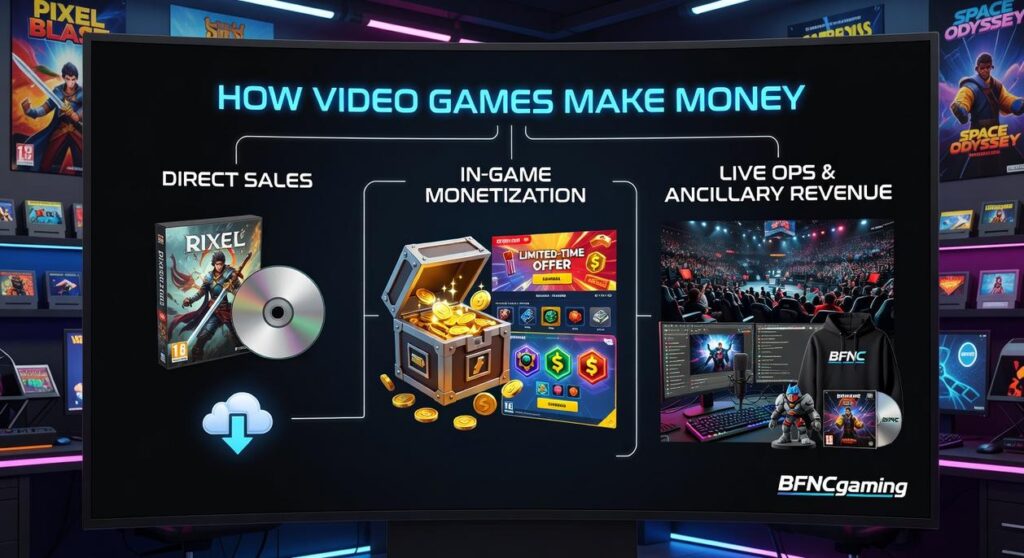
I’ve been analyzing video game business models for years, and most people still think games make money by selling copies.
That hasn’t been the full story in a long time.
You’re probably here because you’ve noticed games are free but somehow making billions. Or you bought a $60 game that keeps asking for more money. The monetization got complicated.
Here’s what’s really happening: how video games make money bfncgaming has evolved into a web of revenue streams that go way beyond the box price. Some games don’t even charge upfront anymore.
I broke down every major way games generate revenue right now. Not the outdated models from five years ago. What’s working today.
We’ve spent years tracking market data and digging through financial reports from major publishers and indie studios. That’s how I know these models inside and out.
You’ll learn about initial sales, live service mechanics, in-game economies, and revenue streams you probably didn’t know existed.
No industry jargon. Just clear explanations of how each model works and real examples from games you’ve actually heard of.
The Foundation: Premium Sales (Pay-to-Play)
You buy the game. You own the game. You play the game.
That’s it.
This is the model that built the industry. One price upfront and you get everything. No strings attached.
I’ll be honest with you. When I first started analyzing how video games make money bfncgaming, I thought this model was dying. I figured everything would go free-to-play within a few years.
I was wrong.
Why Premium Sales Still Work
Here’s what changed my mind. Games like Elden Ring and The Last of Us Part II prove that people will still pay $60 or $70 upfront if the experience is worth it.
The math is different now though. When you buy a physical copy at GameStop, the publisher sees maybe $27 of that $60 price tag after the retailer and distributor take their cuts. Digital sales? The publisher keeps around $42 on platforms like Steam (which takes 30%) or the PlayStation Store.
That’s why you see so many companies pushing digital storefronts.
Single-player games with strong narratives still lean on this model. It works because players know exactly what they’re getting. No microtransactions. No battle passes. Just the game.
Some developers tried to abandon premium sales completely (remember when everyone said single-player games were dead?). They chased trends and lost their identity in the process.
The lesson? Don’t fix what isn’t broken. Premium sales might seem old-school, but they’re still the cleanest way to monetize certain types of games.
Expanding the Experience: DLC and Expansion Packs
Let me clear something up right away.
DLC and expansion packs aren’t the same thing. But most people use these terms like they mean the exact same thing.
They don’t.
DLC is the smaller stuff. Think new character skins, weapon packs, or maybe a single mission. You download it, it adds something to your game, and you keep playing. It’s usually cheap and quick to make.
Expansion packs? Those are different animals entirely.
These add whole new storylines, maps, or gameplay systems. We’re talking 20+ hours of content sometimes. They’re basically mini-games built onto your original purchase.
Why Publishers Love This Model
Here’s what publishers figured out years ago. Once you’ve built a game and people love it, why stop there?
You’ve already got the engine. The assets. The player base. So you keep building on top of what works.
This is how video games make money bfncgaming after the initial launch window closes. Instead of revenue dropping off a cliff after month two, it keeps trickling in (or sometimes pouring in) for years.
Players stay engaged. The community stays active. And the money keeps flowing.
Take The Witcher 3. CD Projekt Red could’ve called it done after the base game launched. Instead, they released Hearts of Stone and Blood and Wine.
Those expansions didn’t just add content. They added entire regions and storylines that some players say rival the main game. Blood and Wine alone gave you 30+ hours of gameplay.
The result? The game stayed relevant for years instead of months.
The Dominant Paradigm: Games as a Service (GaaS)

Remember when you bought a game and that was it?
You paid $60, got the disc, and owned it forever. No updates. No extra charges. Just the game.
Those days are mostly gone.
Now we’re living in the Games as a Service era. And whether you love it or hate it, you need to understand how video games make money bfncgaming if you want to know where the industry is headed.
What is GaaS?
It’s simple. Instead of selling you a product once, developers sell you a service that never really ends.
The goal? Keep you playing. Keep you paying.
Some people say this model ruins gaming. That it’s just a cash grab designed to squeeze every dollar from players. And I won’t lie to you, some companies absolutely abuse it.
But here’s what critics miss. When done right, GaaS means you get years of content updates, bug fixes, and new features. Games that would’ve died in six months now thrive for years.
Let me break down the three main ways this works.
1. Subscription Models
You pay monthly or yearly for access. World of Warcraft pioneered this back in 2004, and it’s still going strong. Xbox Game Pass and PlayStation Plus took it further by giving you libraries of games instead of just one.
The benefit? You get constant content without dropping $60 every time something new releases.
2. Battle Passes & Seasons
This is where free-to-play games like Fortnite and Apex Legends make their real money. You download the game for free, then pay around $10 per season for a track of unlockable rewards.
Play enough, and you earn everything on that track. Miss the season, and those rewards are gone forever (which is exactly how they keep you coming back).
The trade-off is clear. You’re not paying upfront, but you’re definitely paying if you want the good stuff.
3. The Reality Check
GaaS isn’t going anywhere. Publishers found a way to turn one-time buyers into long-term revenue streams.
Does it change gaming? Absolutely.
Does it mean every game is worse? Not necessarily. It just means you need to know what you’re getting into before you start playing.
The In-Game Economy: Microtransactions (MTX)
Let me ask you something.
When did buying a $60 game stop being enough?
I remember when you paid once and got everything. Now you boot up a game and there’s a whole store waiting for you.
Microtransactions are exactly what they sound like. Small purchases you make with real money to get virtual stuff. A new skin for your character. Some in-game currency. Maybe a weapon or a boost.
The thing is, not all microtransactions work the same way.
Cosmetic vs. Pay-to-Win
Here’s where it gets interesting.
Some people argue that all MTX are bad. That games should never ask for more money after you buy them. And I get the frustration.
But there’s a real difference between buying a cool outfit for your character and buying actual power.
Cosmetic items don’t change how you play. You’re just customizing your look. Most players accept this because it doesn’t affect competition. You want your character to look good? Fine. Pay for it or don’t.
Pay-to-win is different. This is when you can buy items that make you stronger or give you an edge over other players. Someone drops $100 and suddenly they’re dominating matches because their gear is better.
That’s when players revolt. And they should.
The Loot Box Problem
Now we get to the really controversial part.
Loot boxes (or gacha mechanics in mobile games) work like this. You pay money for a randomized reward. You might get something rare and valuable. You might get junk.
Sound familiar? It should. It’s basically gambling.
You don’t know what you’re getting until after you pay. The odds are usually terrible. And games design these systems to keep you buying more boxes, chasing that rare item you want.
Countries are starting to notice. Belgium banned loot boxes outright. The UK is looking at regulations. Other governments are asking whether this belongs in games that kids play.
The comparison to slot machines isn’t perfect (you always get something, even if it’s worthless). But the psychological hooks are similar enough that regulators are paying attention.
Who’s Really Paying?
Here’s something most people don’t realize about how video games make money bfncgaming.
The business model doesn’t need everyone to spend. It needs a few people to spend a lot.
They call them whales. Players who drop hundreds or thousands of dollars on a single game. Some studies show that around 10% of players generate 90% of MTX revenue. Often it’s even more concentrated than that.
One whale can fund dozens of free players.
Is that sustainable? Depends who you ask. Game companies love it. Players who can’t spend much get to play for free. But the games get designed around extracting maximum money from those high spenders.
And that changes everything about how the game feels.
Beyond the Game: Ancillary Revenue Streams
Most people think game studios make money from selling games.
They’re only seeing half the picture.
The real money often comes after someone buys the game. Or sometimes, without them buying it at all.
I’m talking about merchandising, esports, and licensing deals that turn game characters into billion-dollar brands.
Merchandising: Turning Pixels into Products
Walk into any Target and you’ll see it. Fortnite hoodies. Minecraft plush toys. Pokemon everything.
Game companies figured out something Hollywood knew decades ago. If people love your characters, they’ll buy stuff with those characters on it.
The margins on a t-shirt? Way better than the margins on a $60 game that took four years to develop.
Esports: When Playing Becomes Spectating
Here’s where it gets interesting.
Competitive gaming leagues now fill stadiums. Sponsors pay millions for logo placement. Brands that never touched gaming before are writing checks to reach that audience.
The players compete for prize pools that can hit eight figures. But the real revenue comes from advertising, ticket sales, and broadcast rights.
It’s professional sports but with controllers instead of balls.
Licensing & Media: The Hollywood Multiplier
Remember when video game movies were guaranteed to flop?
That changed. The Super Mario Bros. Movie pulled in over $1.3 billion at the box office (according to Box Office Mojo).
Game studios now license their IP for films, TV shows, and brand collaborations. Each deal brings in revenue without the studio building a single new level.
You might check what video game came out today bfncgaming to see new releases. But the games that came out years ago? They’re still printing money through these channels.
That’s how video games make money bfncgaming beyond the initial sale.
A Multi-Faceted Financial Ecosystem
You now have a clear map of how video games make money.
From the initial purchase to the ongoing service, you’ve seen the full picture. Premium sales, GaaS models, microtransactions, and ancillary revenue streams all work together.
The complexity of game monetization isn’t a mystery anymore.
I wanted you to understand these models because they matter. Whether you’re a consumer trying to make smart choices or someone thinking about creating games, this knowledge changes how you see the industry.
Premium, GaaS, MTX, and Ancillary revenue streams each play a different role. They shape what games get made and how they evolve over time.
Here’s what you should do next: The next time you play, try to identify which of these revenue streams are at work. Watch how they shape your gaming experience.
You’ll start noticing patterns you missed before. That $5 skin purchase funds the free updates. That battle pass keeps the servers running and the community active.
Understanding how video games make money bfncgaming gives you power as a player and insight as an observer.
The industry keeps changing. Your next move is to stay aware of these models and how they affect the games you love.
 cole80 founded BFNC Gaming as a premier destination for enthusiasts seeking a deeper understanding of the digital landscape. With a focus on the intersection of technical skill and industry innovation, cole80 has curated a platform that explores everything from the intricate frame data of fighting game mechanics to the complex world of game development techniques. Under his leadership, the site serves as an essential resource for players looking to master competitive multiplayer strategies while staying ahead of the latest global gaming trends.